Representatives of the Verkhovna Rada of Ukraine took part in the events of the 50th session of the Congress of Local and Regional Authorities of the European Council
A Ukrainian parliamentary delegation paid a working visit to Strasbourg, France.
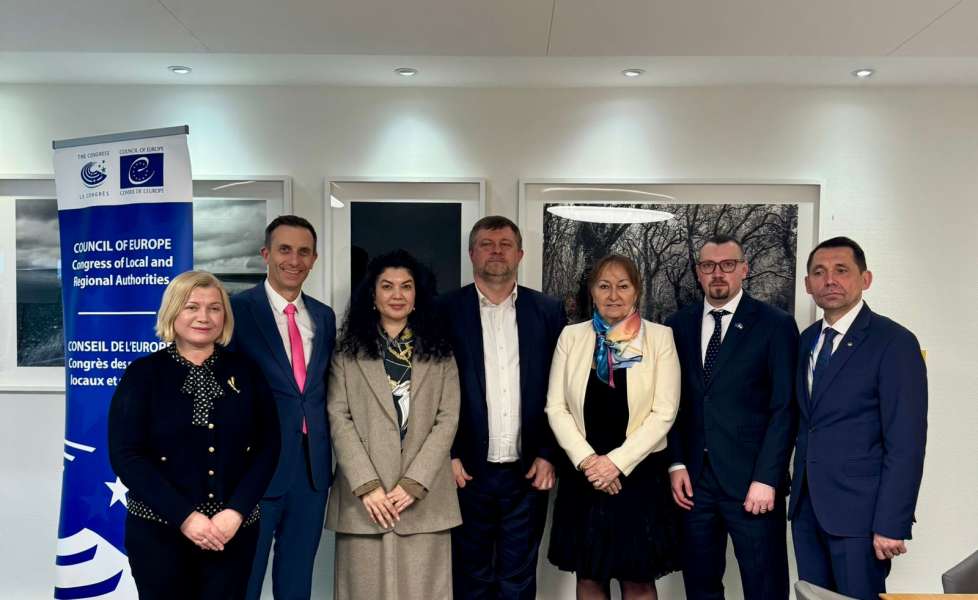
In particular, representatives of the Verkhovna Rada of Ukraine took part in the events of the 50th session of Congress of Local and Regional Authorities of the Council of Europe. The meeting was dedicated to the discussion of key challenges for local and regional governance, the exchange of experience between the representatives of the European Council member-states, consideration of monitoring and thematic reports, as well as the adoption of relevant recommendations and resolutions.
The event was attended by Oleksandr Korniienko, First Deputy Speaker of the Verkhovna Rada of Ukraine; Vitalii Bezhin, Chair of the Subcommittee on Administrative-Territorial Structure and Local Self-Government of the Verkhovna Rada Committee on the Organisation of State Power, Local Self-Government, Regional Development and Urban Planning; Tamila Tasheva, Chair of the Subcommittee on the Restoration of State Authority and Local Self-Government in the Temporarily Occupied Territories of Ukraine, the Autonomous Republic of Crimea and the City of Sevastopol, and Iryna Gerashchenko, a member of the Verkhovna Rada Committee on Foreign Policy and Interparliamentary Cooperation.
The First Deputy Speaker had the opportunity to address the 50th session of the Congress. His speech was dedicated to russian aggression against Ukraine and the state reconstruction at the local and regional levels.
"In my speech I emphasised that russia's war is not only a war against Ukraine. It is also a war against Ukrainian identity, against every Ukrainian and against our communities. This war is against our values and our choice to be a part of the democratic world, where human rights and rule of law are respected," said Oleksandr Korniienko, highlighting that communities were the first to take the brunt of the russian attack, and local and regional bodies are most important nowadays in providing both vital functions and renovation processes.
According to the First Deputy Speaker, despite unprecedented challenges, the system of local self governance has demonstrated resilience which was made possible by the decentralisation reform that strengthened the capacity of communities to act quickly, responsibly, and in accordance with people's needs.
"We are talking about reconstruction based on the "build back better" principle, having taken into account human rights, rule of law and European integration standards. Reconstruction requires not only political will, but also a clear international architecture of justice and compensation. Compensation is not only a matter of justice, but also a real opportunity for communities to rebuild and return people to normal life," emphasised Oleksandr Korniienko.
In this context, he identified the following key interrelated elements: the Register of Damage, an international compensation commission and the establishing of a full-fledged compensational fund. According to Oleksandr Korniienko, only the comprehensive functioning of these mechanisms will ensure justice for the victims of aggression and reconstruction for Ukraine.
At the same time, he noted that reconstruction of Ukraine is impossible without effective multi-level governance.
“We are continuing the decentralisation reform, adapting it to the conditions of war and European integration, in particular by updating the Concept of Local Self-Government Reform, clarifying the division of powers between levels of government, and preparing for the transition from military administrations to civilian governance,” said Oleksandr Korniienko.
He emphasised that the support of the Congress of Local and Regional Authorities of the Council of Europe is extremely important in this process — both in shaping policies and in strengthening the institutional capacity of communities.
“I called for strengthening partnerships between communities, supporting the participation of local authorities in reconstruction processes, and ensuring communities’ access to funding and international programmes,” said the First Deputy Speaker, emphasising that Ukraine is already building its future today – a democratic, sustainable and European one – counting on the continued support of the Council of Europe and the Congress in this process.
Vitaliy Bezhin, for his part, noted that Ukrainian communities and regions are open to new partnerships and joint projects, and are ready to share their experience of local governance in wartime. "We have a unique model of joint efforts and cooperation between military administrations and local government. We know how to establish a system where elected mayors become heads of military administrations and everything works towards achieving results,” he emphasised.
During their visit to Strasbourg, the Ukrainian parliamentary delegation also held a series of bilateral meetings with representatives of Council of Europe member states, the leadership of Council of Europe institutions and international partners.
During the meeting with the Deputy Secretary General of the Council of Europe, Bjørn Berge, the parties focused on the issue of an international tribunal, mechanisms for holding the russian federation to account, and the steps necessary for the international tribunal to become fully operational.
“Every day, not only Ukrainians but the whole world bears witness to horrific acts of terror: crimes against our people, homes reduced to rubble, towns wiped off the face of the earth. russia is killing Ukrainians. Of course, we all seek and demand justice, which must be legally enshrined at the highest international level. russia will not be able to escape justice. Ukraine will achieve this,” said the First Deputy Speaker.
Representatives of the Verkhovna Rada of Ukraine also met with the Secretary General of the Parliamentary Assembly of the Council of Europe, Despina Hatzivassiliou, with whom they discussed the electoral process in Ukraine, once the necessary security conditions are in place – the main factor influencing the possibility of holding elections in our country.
Oleksandr Korniienko briefed the Secretary General of the Parliamentary Assembly of the Council of Europe on the results of the Working Group’s activities regarding the preparation of legislative proposals on elections during exceptional or post-war periods. Particular attention was paid to the challenges, notably ensuring the electoral process for military personnel, supporting the Central Election Commission, the election observation system and improving its methodology.
“The Ukrainian parliamentary delegation shares the view that elections cannot be held during martial law,” emphasised Iryna Gerashchenko, a member of the Verkhovna Rada Committee on Foreign Policy and Interparliamentary Cooperation, during meetings with her European colleagues.
A Ukrainian parliamentary delegation discussed Ukraine’s institutional readiness to prepare for the electoral process, which will take place once appropriate security conditions are in place, with the newly elected President of the Congress of Local and Regional Authorities of the Council of Europe, Gunn-Marit Helgesen, and the Secretary General of the Congress, Mathieu Moret. The parties reached a joint conclusion: for the future elections to be effective and transparent, it is critically important to clearly delineate competences so that every body and every participant in the process has a clear understanding of their area of responsibility.
“We also focused on the role of international platforms, in particular the Reconstruction Conference. This is not merely a diplomatic event, but a real practical tool that we must utilise to the fullest to prepare all the priorities of our recovery.
“In this context, we also discussed the practical aspects of regional cooperation, as it is at the level of communities and regions that strategic plans are directly implemented,” said Oleksandr Korniienko, First Deputy Speaker of the Verkhovna Rada of Ukraine.
During meetings with European colleagues, Tamila Tasheva, Chair of the Subcommittee on the Restoration of State Authority and Local Self-Government in the Temporarily Occupied Territories of Ukraine, the Autonomous Republic of Crimea and the City of Sevastopol, also emphasised the need to overhaul the governance system in the temporarily occupied territories and the procedures for restoring state authority following de-occupation. She emphasised that for Ukraine, this issue is much broader than mere institutional restoration. It concerns the phased return of the state through the provision of security, justice, the restoration of trust and the protection of human rights.