Ukrainian parliamentary delegation met with the Vice-President of the European Commission for Democracy through Law (Venice Commission)
Within a working visit to Strasbourg, France, a Ukrainian parliamentary delegation consisting of representatives from different factions and groups met with the Vice- President of the European Commission for Democracy through Law (Venice Commission), Eirik Golmoivik.
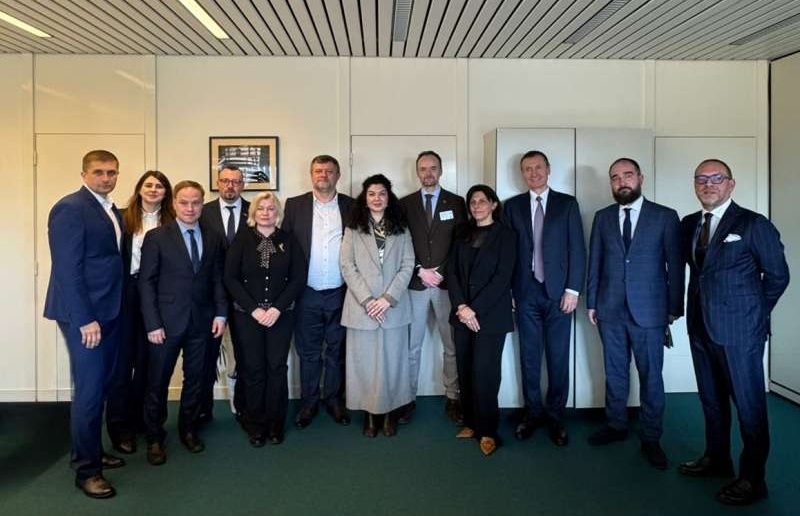
The parties noted a well-established constructive dialogue between Ukraine and the Commission. They outlined the need to ensure a full and effective functioning of democratic institutions of Ukraine, even during wartime. In addition, they discussed the possibility of expanding the Commission’s support at the regional level.
The First Deputy Speaker thanked the Venice Commission for its ongoing support for Ukraine and active expert assistance, highlighting the long-standing dialogue with international experts.
During the meeting, he outlined the structure of the Working Group on the preparation of legislative proposals concerning elections in exceptional or post-conflict periods, as well as the key issues under discussion, particularly those relating to transparent and democratic electoral procedures in temporarily occupied territories, and respect for electoral rights and human rights in general.
Oleksandr Korniienko also emphasized the importance of preserving Ukraine’s democratic institutions even during wartime, as well as the necessity of actively involving local authorities in the electoral process. He highlighted the significance of international support, in particular from the Venice Commission and the Council of Europe, which are ready to provide consultations and expert recommendations.
Separately, the First Deputy Speaker drew attention to the challenges caused by the scale of russia’s war against Ukraine, including urgent issues related to internally displaced persons, refugees in Europe, and infrastructure destruction along the front line.
Tamila Tasheva, Chair of the Subcommittee on the Restoration of State Authorities and Local Self-Government in Temporarily Occupied Territories of Ukraine, including the Autonomous Republic of Crimea and the city of Sevastopol, highlighted the extensive experience of the Venice Commission in working with Ukraine.
“It is critically important for us to receive their expert guidance on sensitive legislative decisions. This particularly concerns the draft law on the status of the indigenous Crimean Tatar people. We are working to ensure that Ukraine’s experience of resilience and democratic transformation forms the foundation of a strong post-war state,” Tasheva said. She also raised issues of political lustration and electoral restrictions during the first post-war elections.
Vitaliy Bezgin, Chair of the Subcommittee on Administrative-Territorial Structure and Local Self-Government of the Verkhovna Rada Committee on State Organization, Local Governance, Regional Development, and Urban Planning, informed the Venice Commission of the absolute consensus within the parliamentary Working Group preparing legislative proposals on elections in special or post-war periods. He emphasized the impossibility of organizing polling stations in the territory of the russian federation, the Republic of Belarus, and temporarily uncontrolled areas of Ukraine.
“In addition, we discussed existing experience in organizing elections under similar conditions, and our European colleagues confirmed that no country, including Balkan states such as Bosnia and Herzegovina or Croatia, has comparable experience. Therefore, unfortunately, Ukraine will have to be a pioneer,” he noted.
Serhiy Vlasenko, a member of the Committee on Legal Policy, reported that the meeting also addressed the issue of consistency in the Venice Commission’s opinions. In particular, attention was drawn to instances where multiple recommendations were issued on the same draft law with differing content, which complicates their practical application in the legislative process of the Verkhovna Rada of Ukraine. According to him, the Commission assured that the comments raised would be taken into account and expressed readiness for further cooperation, including providing advisory support to the Ukrainian Parliament.
At the same time, Iryna Herashchenko, a member of the Verkhovna Rada Committee on Foreign Policy and Interparliamentary Cooperation, highlighted to the Venice Commission the security challenges faced by Ukrainian communities due to destroyed infrastructure and the urgent need to restore the energy system. She also emphasized the importance of continuing the decentralization reform and supporting Ukraine’s development as a democratic state even during wartime. Furthermore, she called on European partners to assist in establishing a tribunal on russia’s crime of aggression against Ukraine and to increase pressure on russia to achieve a just peace for Ukraine.
The meeting with the Vice-President of the European Commission for Democracy through Law (Venice Commission), the meeting was attended by First Deputy Speaker of the Verkhovna Rada of Ukraine Oleksandr Korniienko, Chair of the Committee on Freedom of Speech Yaroslav Yurchyshyn, Chair of the Subcommittee on Administrative-Territorial Structure and Local Self-Government of the Committee on the Organisation of State Power, Local Self-Government, Regional Development and Urban Planning, Vitalii Bezgin; and the Chair of the Subcommittee on the Restoration of State Authority and Local Self-Government in the Temporarily Occupied Territories of Ukraine, the Autonomous Republic of Crimea and the City of Sevastopol of that Committee, Tamila Tasheva; Serhiy Kozyr, Chair of the Subcommittee on the Oil, Oil Transport and Petroleum Products Supply Sector of the Committee on Energy and Housing and Communal Services, and Oleksandr Yurchenko, Chair of the Subcommittee on Household Waste Management of that Committee, Iryna Herashchenko, a member of the Committee on Foreign Policy and Interparliamentary Cooperation; Serhiy Vlasenko, a member of the Committee on Legal Policy; and Mykhailo Papiev, Secretary of the Committee on Rules of Procedure, Parliamentary Ethics and Organisation of the Work of the Verkhovna Rada of Ukraine.